Deploy

Real-world marine deployments that validate autonomous sensing, communication, and energy harvesting.

Field deployments

PEARL has been deployed across multiple real-world marine environments to validate long-duration autonomous sensing, communication, and energy harvesting capabilities.

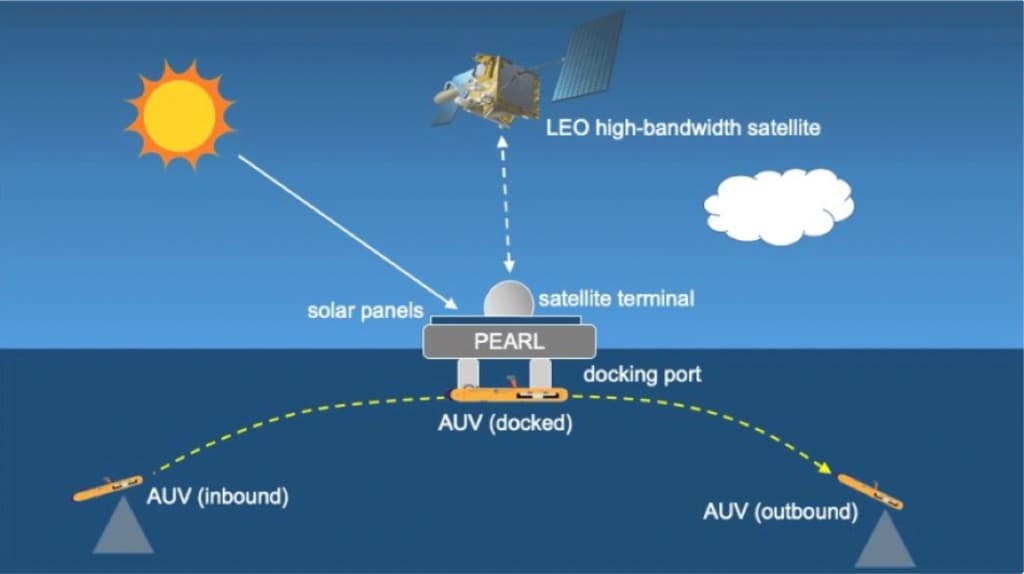
Deployment cycle diagram

Concept view of PEARL supporting inbound and outbound AUV operations with solar power and satellite communications.

PEARL deployment concept showing solar panels, satellite terminal, docking port, and AUV inbound-outbound cycle.

Where PEARL has been deployed

Early prototype — Deep Pond, Orleans, MA

Early prototype deployments were conducted in Deep Pond, Orleans, Massachusetts, where the system underwent extended stress testing over several months to evaluate autonomous operation, solar-powered endurance, environmental sensing, and remote communication performance.

Pleasant Bay — community partnership

Later deployments expanded to Pleasant Bay, Massachusetts, in partnership with Pleasant Bay Community Boating, where PEARL operated as an autonomous smart buoy collecting atmospheric and ocean environmental data in near real time.

Recent field work

More recent deployments have also supported autonomous maneuvering, AUV docking demonstrations, coastal monitoring research, and thermal digital twin validation studies.

Why deployments matter

These field deployments continue to support the broader MIT vision of extending autonomous underwater vehicle range and enabling persistent low-cost ocean monitoring through renewable energy and satellite-connected surface platforms.